Home / Baseball Arm Injury Guide / Shoulder Pain in Baseball Players
Your shoulder hurts when you throw. Maybe it only shows up on long toss day. Maybe it shows up warming up and never leaves. Either way you are here because something changed and nobody has given you a straight answer. And if you're not a baseball player and have shoulder pain, you'll want to stick around because chances are this still applies to you.
This guide gives you one. It covers what actually gets injured in a throwing shoulder, how to tell soreness from a problem, and what to do this week. We see these injuries every week at our Lakewood and Centennial clinics, and families drive in from across Colorado to ask for help.
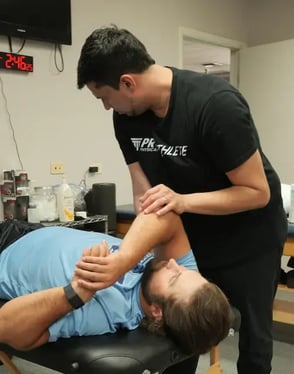
One thing up front. Rest is not Recovery.
Resting stops the pain because you stopped picking the scab. It does not build the strength or the flexibility needed to stop this from happening in the first place.
If you want to try and fix this on your own, download our FREE Arm Pain Guide for exercises to fix your shoulder pain.
If the athlete is 8 to 16 years old and the pain sits high on the outside of the upper arm, this may not be your guide. That pattern points to a growth plate injury. Read our Little League shoulder guide instead. This page covers the injuries that show up once the growth plates sloses, in high school, college, and professional athletes.
It means something changed, and your arm is telling you before it quits on you.
In a throwing shoulder it is usually one of three things: the rotator cuff, the labrum, or tendons getting irritated. Which one it is comes down to where it hurts, when in the throw it hurts, and whether the joint feels like it slips. Realistically, this is the case for most athletes and most sports.
For baseball players (and honestly most athletes) with shoulder pain, they usually have bad of shoulder/trunk flexibility, bad strength and/or are training without a plan. On top of that, athletes rarely sleep enough or eat enough of the right kinds of foods to fuel their body. The end-result is, well, you reading this page right now.
Here is the short version: If it faded within two days and it was spread across the muscle, that was soreness. If it is sharp, sits in one specific spot, or is still there on day three, that is not soreness. That is not going to sort itself out by ignoring it.
An athletic/throwing shoulder trades stability for motion. It gives up some of its grip on the joint to buy the range you need to stretch the arm where it needs to go.
Think of a golf ball sitting on a tee. The socket is shallow on purpose. That shallowness is what lets you get to full layback and rip a ball across the diamond. It's also what let's you pull off 20 seconds of kipping pullups at once.
It is also why the same handful of parts break down in athletes and almost nowhere else.
The rotator cuff is four small muscles that hold the ball of the shoulder centered in the socket and slow your arm down after violent motions like throwing and kipping pull-ups.
In plain terms, the cuff is the brakes, not the engine. Your legs and trunk make the speed. The cuff has to stop it. When people say rotator cuff injury they mean one of three things: tendinosis, which is a tendon that has gotten irritated and stringy over time, a strain, which is a pull, or a full tear.
Rotator cuff injury is the most commonly reported specific diagnosis in a college dataset and the most common shoulder diagnosis in professional position players (Ishikawa et al., 2025; Marigi et al., 2022). If you had to bet on one answer, this is it.
%20and%20the%20surrounding%20bones..webp?width=500&height=273&name=A%20labeled%20medical%20diagram%20illustrating%20the%20posterior%20view%20of%20the%20shoulder%2c%20showing%20the%20four%20muscles%20of%20the%20rotator%20cuff%20(supraspinatus%2c%20infraspinatus%2c%20teres%20minor%2c%20and%20subscapularis)%20and%20the%20surrounding%20bones..webp)
The labrum is a ring of cartilage around the rim of the socket that makes the socket deeper and helps stabilize the shoulder.
Picture a golf ball on a tee - the labrum acts as an extension of the tee that wraps around the bottom portion of the golf ball.
Labral pain usually feels deep and hard to point at, sometimes with a catch or a click at one specific point in the delivery. In one study of 33 pitchers at a Major League Baseball scouting event, 75.8 percent had a labral finding on MRI (Fortney et al., 2024).
Among professional position players, labral tears were the shoulder injury most likely to end a season and most likely to require surgery, with SLAP tears ending 35.3 percent of seasons and requiring surgery 45.1 percent of the time (Marigi et al., 2022).
Impingement is when the cuff tendons get squeezed under the bony roof of the shoulder. The bursa is a small fluid filled cushion that sits in that same space to help everything glide.
In plain terms, there is a hallway in your shoulder and the tendons run through it. Lose motion or control and the hallway gets narrower. Bursitis just means that cushion got angry from being squeezed.
This is the same rule we use on our page about why icing and waiting do not work, and it holds for the shoulder.
Normal soreness feels like general muscle tiredness or achiness. It spreads across a big area. It shows up when you up'd your volume or intensity. And it is gone in 24 to 48 hours.
A problem is sharp. It sits in one spot you can point to with a fingertip. It shows up during the throw/activity, at the same point in the motion every time. It is one sided. And it is still there past 48 hours.
We name these on our elbow guides because a name is easy to remember. Same idea here.
One more: Pain that runs past the elbow or into the hand is a different conversation. That pattern points toward a nerve, and it gets looked at promptly rather than watched.
Bonus: if you can take a tennis or lacrosse ball and lean into your shoulder blade and it makes the pain spread into your arm and hand, this is likely an infrapsinatus trigger point which we can help you with.
First of all, if you want our free "is my arm is cooked?" test which includes specific instructions and exercises to try and fix this now, just follow the link.
Here is what actually helps right now:
It depends on what is hurt, and anyone giving you a number without examining you is guessing. Impingement problems caught early are usually weeks, not months, because the fix is strength, capacity, and learning how to load properly.
Labral injuries can take longer and are the group most likely to need a surgeon involved. Among professional position players they were the shoulder injury most likely to end a season (Marigi et al., 2022). However, most good surgeons know that physical therapy is the first line of defense for these issues and can often times fix the issue without needing surgery.
Two things move the timeline more than anything else. How long you waited, and whether the plan actually loaded the arm instead of avoiding it. Waiting out a season on rest alone is the most expensive thing you can do with your time.
Same five pillars we use across every guide on this site: sleep, nutrition, strength, mechanics, and recovery:
None of that requires a clinic. If you do those six things, you have removed most of the risk. For the full breakdown, read our Baseball Arm Injury Guide.
Shoulder and elbow problems travel together, and plenty of athletes have both. If the pain is on the inside of the elbow, start with our UCL injury guide. If the athlete is still growing, read Little League elbow. If someone has already said the words Tommy John, read the Tommy John guide before you decide anything.
We are a baseball and overhead athlete practice. Dr. Porras spent time on the Minnesota Twins medical staff and Thaddeus Hayes spent five years as a Twins athletic trainer, so the standard we hold your shoulder to is the one used before a professional pitcher is cleared to throw another inning.
We are private pay, so no insurance company decides how long your appointment runs or what your plan looks like. We do accept HSA/FSA accounts.
If it has been hurting more than a week, the next throw is not going to sort it out. Take 15 minutes and find out what you are dealing with. Families come to us from across the Denver metro and the Front Range, including Aurora, Boulder, and Highlands Ranch.
It means something changed, and your arm is telling you before it quits on you. In throwers it is usually one of three things: the rotator cuff, the labrum, or the tendons and bursa getting pinched. Which one it is comes down to where it hurts, when in the throw it hurts, and whether the joint feels like it slips. You cannot settle that from a website. You can settle whether it is worth getting checked, and the rest of this page walks you through that.
Stop throwing/painful activity that day. Just for now. Then over the next two days write down three things: exactly where it hurts, what point in the movement it hurts, and whether you lost range of motion or strength compared with the other side. Get it looked at that same week if something popped, if it hurts at rest or at night, or if the arm feels weak doing normal daily things. Those three notes make the first appointment far more useful than showing up and saying it hurts.
Soreness after an outing is normal. Pain that shows up at the same point in the delivery, sticks around more than a week, or comes with velocity loss is not. Those are two different things, and treating them the same is how small problems become big ones.
Where it hurts narrows things down quickly.
Treat this as a starting point, not a diagnosis. Two players can point at the same spot and have two different problems.
Probably not. Ice just distracts your brain from the actual issue. It does not do any of the rebuilding. We wrote a full breakdown of why icing and waiting do not work, and it is worth reading before you settle on a post outing routine.
The labrum is the ring of cartilage that deepens the shoulder socket. A tear in it is cartilage damage, not a muscle strain, so it behaves differently. It usually feels deep and hard to point at, sometimes with a catch or a click at one specific point in the delivery. Could it be what you have? Yes, but it is less common than a cuff problem. The pattern that raises suspicion is a deep ache plus a sense that the joint is moving somewhere it should not.
Statistically it is the single most likely answer. Rotator cuff injury was the most commonly reported specific diagnosis across six years of PAC-12 college baseball and the most common shoulder diagnosis in professional position players (Ishikawa et al., 2025; Marigi et al., 2022). But most likely is not the same as yes. Cuff pain usually builds over weeks rather than arriving in one throw, tends to sit in the outer arm, and gets worse with overhead work, all without the joint feeling loose.
Four questions sort it most of the time.
Answer pain to three of the four and stop guessing. Get it looked at.
Maybe. Full shutdowns are sometimes needed, but they are the exception once growth plates have closed. In most cases we lower volume and intensity while loading the shoulder in the gym, so the arm keeps its throwing tolerance while it gets stronger.
Not usually, and an image on its own can mislead you. In a group of 33 pitchers averaging 17.9 years old at a Major League Baseball scouting event, 93.9 percent had rotator cuff findings on MRI, and the study describes them as asymptomatic (Fortney et al., 2024). What matters is whether the shoulder can do the job. We start with an exam and refer for imaging when the findings call for it.
Rotator cuff injury, which covers tendinosis, strains, and tears. It was the most commonly reported specific diagnosis across six years of PAC-12 college baseball and the most common shoulder diagnosis in professional position players (Ishikawa et al., 2025; Marigi et al., 2022).
Labral tears. Among professional position players they were the shoulder injury most likely to end a season and most likely to require surgery (Marigi et al., 2022).
If you're 16-17 years old or older, it is not likely. Little League shoulder is a growth plate stress injury, and it only happens while the growth plate is still open, usually ages 8 to 16. The injuries on this page are cuff, labrum, and bursa problems that show up once the growth plate has closed. Same complaint, different structure, different plan. If the athlete is under 16, start with the Little League shoulder guide.
Sometimes, and it depends on the diagnosis. One useful detail from the professional data: in position players the front batting shoulder needed surgery more often than the back one, 8.2 percent versus 6.2 percent (Marigi et al., 2022). This is a conversation to have after an exam, not a rule to read off a website.
Start with a free 15 minute call. We will tell you whether an evaluation makes sense and get you on the schedule at Lakewood or Centennial.
Disclaimer: This page is for educational purposes only and is not a substitute for professional medical advice, diagnosis, or treatment. Shoulder pain can have many causes, some minor and some serious. If you or your athlete are experiencing pain, please consult a qualified medical provider for an individual evaluation before starting or changing any treatment or training program.
