Home / Baseball Arm Injury Guide / Little League Elbow
Written by Dr. Edwin Porras, DPT, Board Certified Orthopedic Specialist and published author on baseball throwing programs, former Minnesota Twins medical staff. Co-authored by Thaddeus Hayes, MAT, LAT, ATC, former Minnesota Twins athletic trainer.
Every year, thousands of baseball players between the ages of 9 and 13 experience sharp inside elbow pain that derails their season.
What coaches and parents write off as a mechanical flaw or a minor muscle ache is often the early warning sign of a serious baseball arm injury. Ignoring these early red flags can lead to bone damage or surgery. Knowing how to spot Little League elbow early is the most important step you can take to protect your child's throwing arm.
Little League elbow is an overuse injury that targets the developing bones of a young athlete. Unlike older baseball players who damage muscles or ligaments, youth players have soft, active growth plates at the ends of their bones (Frush and Lindenfeld, 2009).
The growth plate is the softest spot in a young elbow, which makes it the first thing to fail. Throw after throw, the ligament pulls on it until it starts to separate from the bone (Parks and Ray, 2009).
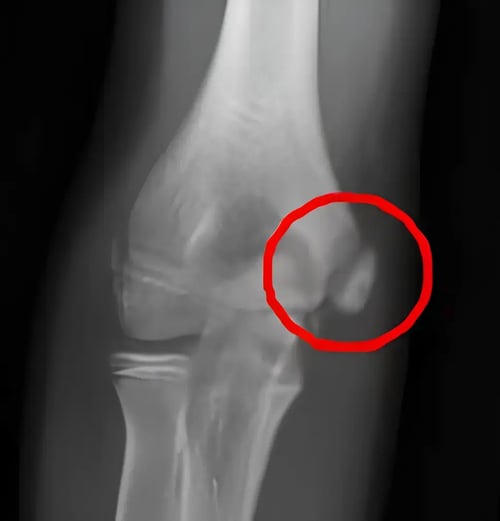
Pitching whips the arm from rotating back to rotating forward almost instantly, forcing the elbow to snap inward while the forearm flies outward. That motion creates a force called valgus stress, and it twists the inside of the elbow harder than an adult UCL and a child's growth plate can handle on its own. Since open growth plates are softer than ligaments in kids, the growth plate is the first to fail.
Cadaver testing (done on humans who donated their body for scientific studies) show the ligament tears on its own unless the forearm muscles fire at max effort on every pitch to absorb the overflow. Tired muscles mean an unprotected ligament. That is why pitch counts, rest and fatigue matter more than mechanical tweaks.
Here are just a few more things research has linked to Little League elbow:
Throwing too many pitches without enough rest
Pitching while fatigued
Playing on multiple teams at the same time
Pitching and playing catcher in the same season
But how much is too much?
Youth pitchers who throw more than 100 competitive innings in a single year are 3.5 times more likely to suffer a severe arm injury.
Averaging more than 80 pitches per game nearly quadruples the risk of major elbow surgery.
Pitching competitively for more than 8 months out of the year spikes surgery risk by five times (Fleisig and Andrews, 2012).
If your child experiences any of the following, stop throwing immediately. Continuing through these signs can cause the growth plate to fracture completely or break away from the bone. Untreated, this leads to bone deformities and joint damage.
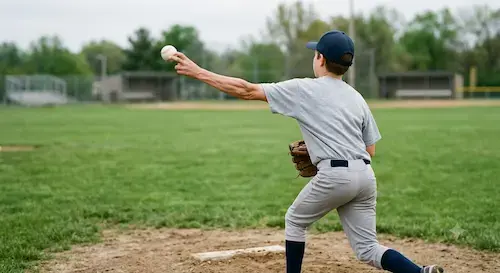
Follow these four prevention pillars to keep your athlete on the field:
Follow age-specific pitch guidelines: Stick to daily pitch count limits and mandatory rest days (Gregory and Nyland, 2013). When leagues enforce pitch counts instead of just counting innings, elbow pain and arm stiffness in kids drops significantly (Matsuura et al., 2021). For more specific guidance, read the full guidelines.
Take at least 4 consecutive months off throwing every year: Young athletes need at least four months away from competitive overhead throwing annually to let their body recover. Year-round pitching is one of the strongest predictors of eventual surgery (Fleisig and Andrews, 2012).
Play multiple sports: Early sport specialization is a documented risk for Little League elbow and UCL injury later in a career. Soccer, basketball, and track build better athletes and unload the throwing arm.
Speak up early: Catching the injury when it is mild irritation might mean three weeks of modified activity. Staying quiet might mean six months on the bench.
It is very common for players to be diagnosed with Little League elbow without a clear fracture or major damage on X-rays. But that does not mean resting for 4 weeks (without physical therapy) solves the problem. Rest is not Rehab. Rest without a plan to rebuild strength is just time wasted. Plenty of families get advice from their doctor to just rest, so they do. But they jump back into throwing, re-injure the elbow, and this time there's clear damage on X-ray.
Here's what to do if you think your athlete has Little League elbow:
1. Schedule an appointment with an orthopedic surgeon (if you have to start at the pediatrician, ask for a referral to an orthopedic doctor).
Here's why: some doctors only X-ray the sore arm but there is no single "normal" picture. The only way to know what "normal" looks like for your son is to compare his sore elbow to his healthy one.
Little League elbow shows up as a small widening or chipped piece of bone at the medial epicondyle. Easy to miss on one image. Obvious side by side.
If the doctor pushes back on radiation, that is fair. Ask for an MRI referral or a sports medicine doctor who treats baseball players.
3. Even if the doctor doesn't recommend it directly, ask for a referral to a baseball-specific physical therapist. If you go to a big medical facility, make sure to still ask for a list of other PT clinics because their default is to send you in-house.
A complete Little League elbow recovery requires a structured plan. You cannot rely on a calendar date to decide when your child is ready. True recovery is based on strength testing and hitting milestones, not how many weeks have passed.
At PRO Athlete PT for 9-13 year olds, we recommend a 12-week shutdown from all throwing plus a rehab plan. The athlete needs focused physical therapy and the growth plate needs time to heal since bone injuries take time. The blunt truth is that a child this age does not need to risk further injury as this could become a quality of life issue in the future.
But this does not mean sitting still. Our program includes three key things:
1. Tracking strength and flexibility data and pain to know when to progress. There should be no guesswork.
2. Strengthening and stretching of the elbow (when able), shoulder, hips and core. A weak or unstable body forces the elbow to take on extra stress.
3. An intelligently designed throwing program built by experts. Athletes should not go from zero throwing for three months to a bullpen.
PRO Athlete Physical Therapy was built by two former Minnesota Twins medical staff members. Edwin Porras, DPT, OCS is a Board Certified Orthopedic Specialist, a PubMed-published researcher, and a former Twins physical therapist. Thaddeus Hayes, MAT, LAT, ATC spent five years with the Twins organization as an athletic trainer. This is not a general PT clinic. It is baseball-specific care built by people who have treated professional baseball players.
Every evaluation is 75 minutes, one-on-one, hands-on. Most programs treat the elbow in isolation. We assess the whole body and gather throwing history and workload patterns. We look at the whole athlete because that is how injuries actually happen. Rest is not Rehab. Rest without a plan to rebuild strength is just time wasted.
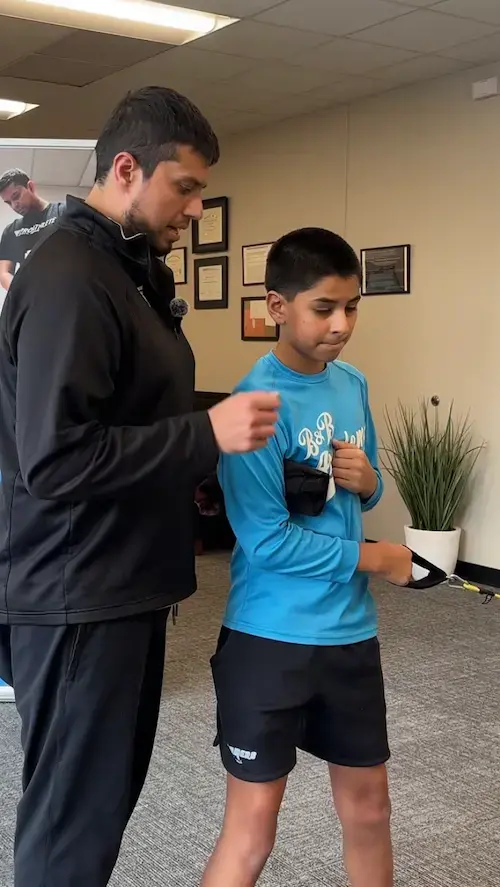
From there we build a plan with objective metrics so you know exactly what needs to happen before he returns to the mound. No ice bags as a treatment plan. No cookie-cutter protocols.
Rest is not Rehab. We use active, progressive loading specific to where the athlete is right now and where he needs to go.
If your athlete plays in the Denver Metro, Front Range, Lakewood, Centennial, Aurora, Boulder, or Highlands Ranch area and his elbow pain is not going away, a phone call with us is the right first step. If you're not in the Denver area, we have remote options available.
His arm is not going to get stronger on its own.
If his elbow pain has lasted more than two weeks, or it came back after rest, it is time to get a real answer. Book a free call with our team. We will tell you exactly what is going on and what needs to happen next. No ice bags. No guessing.
No. Increased blood flow during warmups temporarily masks pain, but the throwing motion continues to damage the growth plate underneath. Playing through can make the bone injury worse.
No. Tommy John surgery repairs a torn UCL, which is a ligament injury in athletes whose growth plates have matured. Little League elbow is a bone injury to the open growth plate found only in younger athletes. They share some symptoms and risk factors but are different injuries. You can read more on our UCL injury guide page.
This is usually not the first step. A clinical evaluation by a baseball specialist can identify the injury. If your son experiences red flags like joint locking or a clear pop, imaging may be warranted. Get the eval first.
We recommend at least 4 weeks and at times up to 12 weeks. Every injury and athlete is unique but if there's significant damage to the growth plate, a baseball specific physical therapy program and rest should fix the problem. Make sure to check with your doctor before returning.
In many states, you can access a physical therapist without a doctor's referral. If you don't live in one of those states, just ask your doctor for a referral to PT.
Find a baseball specific physical therapist. This is one of the most common situations we see in our clinic. General physical therapy is not enough. If the program does not include a total body evaluation, sport-specific loading and a return-to-throw program, it likely did not address the full picture. Book a call and we will walk through what is missing.
No. Position players with high throw volumes can develop it too. Pitchers are most common because of throw frequency and intent. Any position player throwing year-round at high volumes is at risk.
Ages 9 to 16 are the highest-risk window, with 10 to 13 being most common. That is when competitive throwing volume peaks and growth plates are still fully open.
Yes, and this is the most important reason not to let it linger. A growth plate that is repeatedly stressed and never fully healed can alter the mechanics of the elbow over time. The altered mechanics shift load onto the UCL with every throw. Players who return too early or skip rehabilitation are significantly more likely to develop UCL problems in high school and college (Osbahr, 2024). The goal of treatment is not just to get him back on the mound. It is to protect the elbow he will be throwing with for the next ten years.
The standard is a minimum 4 to 12 weeks followed by a structured return-to-throw progression that rebuilds arm speed gradually over 8 to 12 additional weeks. Not just when the pain is gone. Pain resolves before the growth plate is healed. In our experience, full-effort throwing before completing that progression is the single most common cause of re-injury. If another provider cleared your son to throw at full intensity in under 8 weeks without a second thought, get a second opinion.
Not Sure What Is Going On With His Elbow?
The information provided in this guide is for educational and informational purposes only and does not constitute medical advice. If you or your athlete are experiencing elbow pain, a drop in velocity, or nerve symptoms, do not attempt to self-diagnose. Please consult a licensed physical therapist, athletic trainer, or medical professional for a comprehensive, hands-on evaluation.
References
1. Parks ED, Ray TR. Prevention of Overuse Injuries in Young Baseball Pitchers. Sports Health. 2009;1(6):514-517. https://pubmed.ncbi.nlm.nih.gov/23015915/
2. Gregory B, Nyland J. Medial elbow injury in young throwing athletes. Muscles Ligaments Tendons J. 2013;3(2):91-100. https://pubmed.ncbi.nlm.nih.gov/23888291/
3. Matsuura T, Takata Y, Iwame T, et al. Limiting the Pitch Count in Youth Baseball Pitchers Decreases Elbow Pain. Orthop J Sports Med. 2021. https://pubmed.ncbi.nlm.nih.gov/33796588/
4. Fleisig GS, Andrews JR. Prevention of Elbow Injuries in Youth Baseball Pitchers. Sports Health. 2012;4(5):419-424. https://pubmed.ncbi.nlm.nih.gov/23016115/
