Home / Baseball Arm Injury Guide / UCL Injury Injury in Baseball Players: What Denver and Front Range Parents Need to Know
Written by Dr. Edwin Porras, DPT, Board Certified Orthopedic Specialist and published author on baseball throwing programs, former Minnesota Twins medical staff. Co-authored by Thaddeus Hayes, MAT, LAT, ATC, former Minnesota Twins athletic trainer.
Your son's elbow hurts. As a parent, your mind immediately jumps to the worst-case scenario: Tommy John surgery and a lost season.
Take a breath. Here is what that elbow pain actually means, how we use data to decide if surgery is the right call, and what recovery really looks like. These are plain answers from medical staff who have been in the athletic training room with MiLB and MLB athletes.
If you'd like more information about how to work with us in Lakewood or Centennial we have spots available for your rehab.
If you'd like to try and fix this yourself, download our FREE "is my arm is cooked?" test which includes specific exercises to fix arm pain.
Rest is not Rehab.
Rest without a plan to rebuild strength is just time wasted.
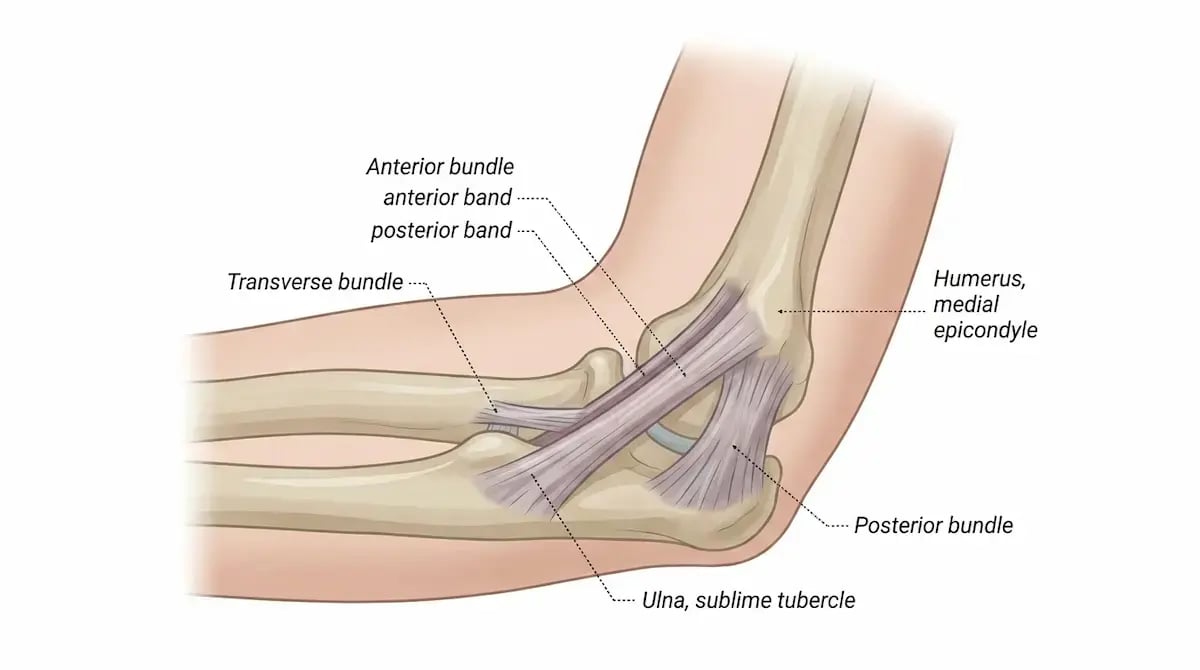
UCL stands for ulnar collateral ligament, the ligament on the inside of the elbow that stabilizes a pitcher's arm during a throw. A UCL injury means that ligament is stretched, partially torn, or fully torn. Not every UCL injury means surgery. Here's how we tell the difference and what we do about it in Centennial and Lakewood.
The Ulnar Collateral Ligament (UCL) is a thick band of tissue on the inside of the elbow. This is the famous "Tommy John ligament".
Think of it as a heavy-duty rubber band that connects the upper arm bone to the lower arm bones. When throwing a baseball, that rubber band absorbs massive amounts of stress.
When that stress adds up faster than the body can recover, the ligament sends signals to the brain that it may be damaged. That signal leads to one word: pain.
According to Princeton Medicine, nearly 50% of all youth baseball injuries come from overuse. While shoulder irritation is the most frequent complaint we see in the clinic, the UCL (elbow) is now the most common injury for major, season-ending injuries in pitchers (to read more about shoulder pain in baseball players check out our full guide).
Key stats:
The Local Problem: "UCL Debt"
Across the country over the last 10 years, the push for year-round baseball (velo programs immediately after a 7-8 month season) has created a phenomenon called "UCL Debt." And the Denver Metro and Front Range are not immune to it.
A study by Chalmers in 2021 shows that the UCL swells over the course of a long season. The ligament only recovers about 60% over a standard off-season.
Players going straight from a fall ball tournament in Aurora to winter velo programs in Castle Rock are starting the new season with a ligament that is already in "debt" from the previous season. Eventually, the bill comes due.
Pain that builds slowly over a season is different from a sudden event, but both need immediate attention. Do not wait for the off-season if you see these red flags:
Red Flags:
No. This is the biggest misconception in baseball.
A 2023 study by Gopinatth (more stats from this study are below) looked at hundreds of athletes with UCL injuries. The result? About 80% returned to play without surgery. They did not need an operation. They needed an MLB-style rehab plan and enough time to let the ligament recover.
For most partial tears, conservative management (Physical Therapy) isn't the backup plan. It is the first move.
What actually decides if surgery is needed
Only a trained orthopedic surgeon can decide if a UCL surgery is necessary. They make this decision with research and experience but lean on the same main rules we follow at PRO Athlete Physical Therapy:
Where the tear sits changes everything
Where the ligament tore changes the odds more than almost anything else. A 2023 systematic review and meta-analysis of 15 studies and 365 athletes found that tears near the top of the ligament returned to sport at a far higher rate than tears near the bottom.
That gap is not noise. It held up as statistically significant across every study in the review. It is also the single most useful question you can ask your son's surgeon: where is the tear? The answer should shape whether rehab is a realistic first path or a delay before an operation that was always coming.
Why the gap? Blood supply. The proximal end gets good blood flow which means it can heal. The distal end does not.
If the MRI says proximal, you have a strong case for non-surgical care. If it says distal, the surgery conversation gets serious fast. Even then, trying rehab first is still on the table. Surgery is permanent. Trying rehab first is not.
Worried his MRI says distal? Get a second set of eyes before the surgery conversation moves forward.
PRP (Platelet-Rich Plasma) involves taking the athlete's blood, spinning it around, and injecting it back into the elbow to try and speed up healing. It sounds cutting-edge and fancy, but the results tell a different story.
The idea sounds great. The data does not back it up.
The same Gopinatth study from earlier compared pitchers who got PRP plus rehab to pitchers who just did rehab. The result? No real difference in return-to-sport rates. The injection added cost. It did not add results.
Ligaments heal when the arm gets adequate rest, and when the mechanical flaws (in the hips, core, or shoulder) that caused the tear are fixed. If a physical therapist misses the fact that a stiff thoracic spine is overloading the arm, no injection in the world will save that ligament in the long-term.
The ligament heals when two things happen:
.webp "Baseball athletic trainer guiding a high school pitcher through non-surgical UCL rehab in Centennial, Colorado.")
Without Surgery (Conservative Management)
Most players who see us with a partial UCL tear are back on the mound in 2-3 months when the plan is followed consistently. The timeline breaks into three phases:
After Tommy John Surgery
From our experience, recovery after UCL reconstruction takes anywhere from 12 to 18 months depending on your surgeon's protocol and your body's response to rehab. The new tissue (usually a tendon from somewhere else in the body like hamstring or forearm) needs time to mature into an actual ligament. Rushing this is the number one reason players suffer setbacks.
People often confuse these two injuries, but the difference is important.
Never assume the diagnosis based on where the pain is. A clinical exam and x-rays or an MRI are required.
%20(1).webp?width=350&height=378&name=Stirm%20(2)%20(1).webp "College baseball pitcher with family after game, post-UCL rehab success in Lakewood, Colorado")
Before a tear happens, players can feel a "heavy arm" where they can't get loose, a sudden 3-5 mph drop in velocity, or inner elbow tenderness. If the ligament finally fails, athletes describe a sharp, electric "pop" and sometimes numbness in the pinky and ring fingers. For most high school and college pitchers, a UCL injury doesn't happen with one bad pitch. It's the result of overuse sometimes over years.
Yes. Recent high-level data shows that approximately 80% of elite throwers can return to play without surgery. However, rest is not rehab. Simply sitting on the couch for four to six weeks causes the surrounding muscles to lose strength. Healing requires controlled loading, restoring lost ligament stiffness, and optimizing the kinetic chain (hips, core, shoulder) to take the stress off the elbow.
Only a trained orthopedic surgeon can decide if a UCL surgery is necessary so if we have any doubt, we make sure to send you to one ASAP. The key is to remove the guesswork by looking at the MRI, specifically the location of the tear. Proximal tears , making them prime candidates for physical therapy.Distal tears (closer to the wrist) have only a 41% success rate, which often means starting with a visit to an orthopedic surgeon trained in baseball.
You can likely begin moving your wrist/hand/fingers within your brace right away. But every surgeon has a slightly different post-op plan and most of them include at least a couple weeks of total rest. New research from Buchanan in 2025 shows athletes who started physical therapy earlier (within 14 days) got back to playing faster without negative effects.
If the elbow is compromised or unstable, the shoulder has to work overtime to protect the arm during the throwing motion. Over time, this compensation pattern causes rotator cuff or labrum pain on top of the elbow injury. This is why our evaluations always assess the entire body, not just the site of the pain. At PRO Athlete PT we like to say that the shoulder is the gateway to the elbow's soul.
"Dead arm" is a term that is a symptom, not a diagnosis. It can be an early warning sign of "UCL Debt" meaning the ligament has lost its stiffness and the arm is struggling to transfer energy. If a player consistently complains of a dead arm, it needs to be evaluated before it turns into a structural tear.
The old "ice your arm after every game" philosophy is dead. Here is the modern, science-backed approach:
Ultimately, neither ice nor heat fixes the root cause of a UCL injury. Active recovery (controlled movement) and addressing mechanical flaws will always outperform passive treatments like ice packs and heating pads.
The information provided in this guide is for educational and informational purposes only and does not constitute medical advice. If you or your athlete are experiencing elbow pain, a drop in velocity, or nerve symptoms, do not attempt to self-diagnose. Please consult a licensed physical therapist, athletic trainer, or medical professional for a comprehensive, hands-on evaluation.
Regarding Tommy John surgery and post-operative care: Every orthopedic surgeon utilizes distinct protocols based on the exact procedure performed (e.g., traditional reconstruction vs. internal brace) and the specific needs of the patient. The timelines and rehab phases discussed in this article represent general frameworks. Always defer to and strictly follow the specific post-operative restrictions and guidelines provided by your surgeon.
PRO Athlete Physical Therapy
5825 W 6th Ave #3a, Lakewood, CO 80214
(720) 248-7515
PRO Athlete Physical Therapy
7240 S Fraser St, Centennial, CO 80112
(720) 248-7527
